


Dream League Soccer 2026
First Touch Games Ltd.
I went into Dream League Soccer 2026 expecting a familiar mobile football game, but what stood out during my time with it was how quickly a short match can turn into a small management routine. It is easy to start playing, yet the best experience comes from understanding where setup, connection, progression, and in-match decisions can create friction. That makes it more interesting than a simple pick-up-and-play sports title, although it also means it is not perfect for every kind of player.
Developed by First Touch Games Ltd., this free sports game uses FIFPRO-licensed soccer as its foundation. It is available for players rated Everyone, runs on devices using Android 6.0 or later, and currently appears as version 13.040. Its popularity is substantial, with an average rating of 4.4 from around 13 million ratings and more than 100 million installs. Those figures suggest a broad audience, but they do not remove the need to check whether its style suits the way you like to play.
Getting past the first points of friction
The first place many players get stuck is not the football itself. It is the transition from installing the game to actually reaching a comfortable playing rhythm. A sports game can feel unresponsive or unstable when the device is busy, the connection is inconsistent, or the player starts with expectations shaped by a console football title. My advice is to treat the first session as a setup period rather than immediately judging the whole experience.
Related News

Before launching, I would close demanding apps, make sure the phone has enough free storage for normal operation, and use a reliable connection for any online-dependent activity. These are simple checks, but they prevent a lot of misleading conclusions. If the game takes a while to load once, that does not automatically mean the installation is broken; the device may simply be handling other work in the background.
The controls also deserve a few matches before you decide whether they feel right. Mobile football controls require a different kind of precision from a physical controller. I found that rushed taps often create more trouble than the opposing team. A short practice period helps you learn how much input is needed for a pass, a change of direction, or a defensive challenge. The important adjustment is to stop treating every touch as a command that must be issued instantly.
Related News

Why WhatsApp Messenger Still Makes Everyday Communication Feel Easy

Jurassic World: The Game Is the Better Dino Tycoon for Strategic Players

Threads in Real Life: Who Should Join, Lurk, or Leave

How SHEIN Turned Shopping Into an Endless Content Feed

How to Make Fortnite Feel Smarter on Mobile

Should You Switch to Microsoft Outlook on Mobile?
Another common stumbling block is choosing an unsuitable playing approach. If you prefer a quick arcade match with almost no planning, the early team-building side may feel like a delay. If you enjoy shaping a squad over time, that same layer gives the matches more meaning. I would not skip the introductory decisions just to reach a game faster, because they establish the habits you will rely on later.
Small setup checks that prevent bigger problems
My first practical check is the operating system. The game supports Android 6.0 and later, but compatibility on paper is only the starting point. Older hardware may technically run a title while still struggling with heat, background memory pressure, or inconsistent frame delivery. If the phone feels warm or the controls seem delayed, lower the workload around the game first: close other apps, avoid playing while the device is charging if it becomes hot, and restart before assuming the game itself is at fault.
I would also check the account and connection situation before spending time on progression. A connection that works for browsing can still be unreliable during a more demanding session. If menus load but a match-related action fails, try switching between a stable Wi-Fi network and mobile data, then restart the game. Do not repeatedly tap a purchase or confirmation button while the screen is waiting; duplicated attempts are more likely to create confusion than solve the original delay.
Gallery
Because the game is free to download but includes optional purchases ranging from $0.99 to $99.99 per item, I recommend deciding your spending boundary before the first serious session. This is not just a budgeting tip. It keeps the focus on learning the football and makes it easier to tell whether a difficult moment comes from your tactics or from the temptation to accelerate progress. I enjoyed it more when I treated purchases as optional rather than as part of the basic installation.
The age rating is Everyone, which makes it approachable for a wide audience, but younger players may still need guidance around in-app purchases and screen time. For a family device, I would set the relevant purchase protections before handing the phone over. That is a better workflow than trying to resolve an accidental purchase after the fact.
How I recovered when a session went wrong
When something stopped behaving normally, I used a simple recovery order instead of jumping straight to reinstalling. First, I left the current screen and reopened the game. If that did not help, I restarted the device and checked the connection. Only after those steps would I consider reinstalling, and I would do that carefully because any game with progression deserves attention to account access and saved progress before local data is removed.
This order matters because reinstalling is a blunt solution. It can clear temporary problems, but it can also create a new problem if you have not made sure you can return to your progress. I would never clear storage or uninstall while an account or save situation is unclear. A few minutes spent checking your login route is safer than assuming the game will reconstruct everything automatically.
If a match appears to freeze, I would first wait briefly and look for signs that the phone or connection is still working. If the whole device is unresponsive, the issue may be broader than the game. If only the game has stopped responding repeatedly, record what was happening immediately beforehand: loading a match, changing a squad decision, or returning from another screen. That detail is useful when deciding whether the problem is repeatable or just a one-off interruption.
Progression problems also need patience. If a reward, team change, or result does not appear immediately, avoid closing the game in the middle of a saving or loading transition. Give the screen time, then reopen the game once rather than repeatedly forcing it to reload. I found that a calm restart is more useful than making several changes at once, because it preserves a clear idea of what actually fixed the issue.
Playing efficiently instead of simply playing faster
The most useful habit I developed was separating a learning match from a progression match. In a learning match, I focused on spacing, passing choices, and defending without chasing every opponent. In a progression match, I used the approach I already understood and avoided experimenting with several unfamiliar decisions at once. This makes it easier to identify whether a poor result came from a tactical mistake, an input error, or a bad run of play.
One non-obvious trade-off is that aggressive attacking can make a match feel exciting while quietly making your own defense fragile. When I pushed forward after every recovery, I often created the exact open space the opponent needed. A more controlled approach—keeping possession for an extra moment and giving defenders time to settle—was less dramatic but more reliable. Players who lose matches despite creating chances should examine what happens immediately after they lose the ball.
Another useful workflow is to change one variable at a time. If you alter your formation, your attacking style, and your player choices after one defeat, you will not know which change helped. I prefer making one adjustment, playing enough to observe its effect, and then deciding whether to keep it. This is especially valuable on a phone, where a small control mistake can look like a major tactical failure.
For short everyday sessions, I would use the game as a focused break rather than trying to complete everything in one sitting. A realistic routine is a couple of matches during a commute break or after work, followed by a quick review of what went wrong. The benefit is that you return with a clear objective: improve passing under pressure, defend without overcommitting, or test one squad change. The downside is that players who want a fully relaxed experience may find even this light planning more involved than expected.
The FIFPRO licensing gives the game a recognizable football identity, but the appeal is not limited to recognizing names. I cared more about whether the team felt like mine and whether my decisions changed the way matches unfolded. That personal connection is one reason it can hold attention beyond a single evening. At the same time, anyone looking for the exact presentation, depth, or controller feel of a major console release should keep expectations realistic and consider a platform built for that experience instead.
When the game is not the cause
It is tempting to blame a game whenever a match feels delayed, a screen loads slowly, or controls seem inconsistent. In practice, the phone can be the limiting factor. Heat, low free storage, background downloads, battery-saving behavior, or an overloaded network can all affect a session. If the problem disappears after closing other apps or moving to a stronger connection, the game may have been reacting to the environment rather than causing the original issue.
Network conditions are particularly easy to misread. A connection can appear fast while still suffering from interruptions. If online activity is unreliable but offline parts of the device work normally, test another network before changing the installation. Restarting the router or moving closer to it may be more useful than repeatedly reinstalling the game.
Input problems can also come from the screen. A protector, damp fingers, a damaged touch area, or a phone case pressing the edge can make taps register poorly. I would test the same gestures in another app before deciding that the football controls are defective. If touch issues appear across the phone, the sensible fix is device-related rather than game-related.
There is also a performance expectation issue. A newer phone may provide a smoother experience than an older Android device even though both meet the minimum operating-system requirement. That does not make the older phone unusable, but it may change how comfortable long sessions feel. If you care most about consistent responsiveness, a device upgrade or a different gaming platform may be a better answer than trying to force every setting and app to behave identically.
Who will enjoy it most, and who should skip it
I would recommend this game to someone who wants recognizable soccer, short mobile matches, and a sense of building a team rather than playing isolated exhibitions. It is especially suitable for players who enjoy learning through repetition and can accept that progress may involve both matches and management decisions. The free entry point makes it easy to test without committing money, provided you remain comfortable with optional purchases.
I would be more cautious recommending it to someone who dislikes touch controls, has an older or frequently overheated phone, or wants a completely offline, interruption-free football game. It is also not my first choice for a player who expects every feature and presentation detail to match a premium console simulation. In that situation, a paid game with a more focused offline design, or a console and controller setup, may deliver a better fit.
Compared with a simple arcade football alternative, this title asks for more patience and involvement. Compared with a heavyweight simulation, it is easier to pick up but less likely to satisfy someone seeking the deepest possible tactical and presentation experience. Its strongest position is between those extremes: accessible enough for a quick match, yet structured enough that decisions outside the immediate kick can matter.
My practical verdict after using it
After spending time with it, I see Dream League Soccer 2026 as a convincing choice for mobile football fans who want more than a disposable match but less complexity than a full console-style simulation. The combination of a free starting point, FIFPRO licensing, familiar sports framing, and a large established player base gives it a strong reason to try. The average rating of 4.4 reflects that broad appeal, although individual enjoyment still depends heavily on device performance and tolerance for optional spending.
My best advice is to install it with a clear routine: check the phone and connection first, learn the controls gradually, change one tactical idea at a time, and restart calmly when a session behaves strangely. Those habits reduce the most common friction and make the actual football easier to judge. They also help separate a genuine game limitation from a problem caused by the device, network, or rushed decision-making.
I would keep it installed if I wanted a regular mobile soccer game for short but meaningful sessions. I would skip it if my priority were a pure offline experience, physical-controller precision, or a completely purchase-free progression path. For everyone in between, it is worth trying free, playing several matches without spending, and deciding based on how the controls and team-building rhythm feel on your own phone. The key trade-off is simple: you get a flexible, approachable football game, but the best results come from treating it as a small ongoing hobby rather than a one-tap arcade distraction.
FAQs for Dream League Soccer 2026
What are the device requirements for Dream League Soccer 2026?
Dream League Soccer 2026 requires an Android device with at least 2GB of RAM and Android OS 8.0 or higher. For iOS users, an iPhone 6s or newer is recommended with iOS 12 or later. Ensure you have at least 500MB of free storage to accommodate the game and future updates.
Is Dream League Soccer 2026 free to play?
Yes, Dream League Soccer 2026 is free to download and play. However, it offers in-app purchases for various items such as player packs, stadium upgrades, and additional customization options. These purchases can enhance your gaming experience but are not necessary to enjoy the game fully.
Does Dream League Soccer 2026 require an internet connection?
While you can play Dream League Soccer 2026 offline in career mode, an internet connection is needed for certain features. Online multiplayer matches, leaderboards, and updates require internet access to ensure optimal performance and access to the latest content.
Can I transfer my progress from Dream League Soccer 2025 to 2026?
Unfortunately, Dream League Soccer 2026 does not support direct progress transfers from previous versions. Players will need to start fresh, but the game offers new features and improvements that enhance the overall experience, making it worth the transition.
What new features are included in Dream League Soccer 2026?
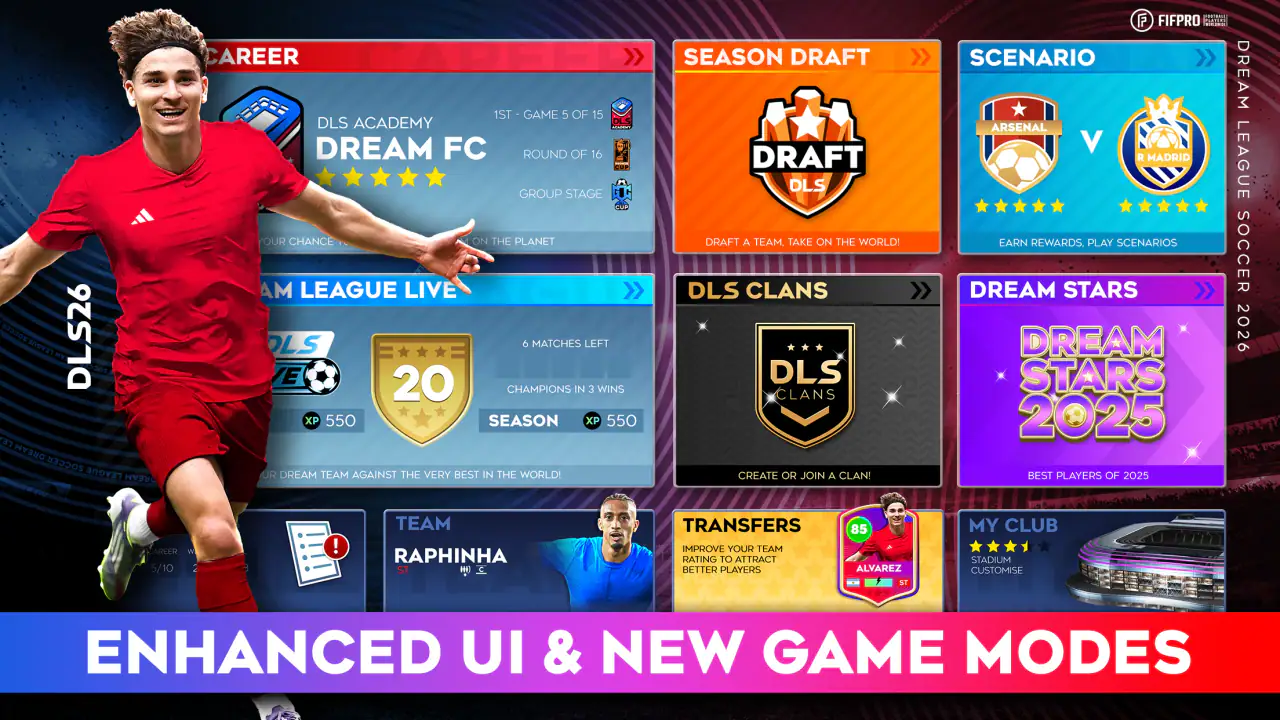
Dream League Soccer 2026 introduces improved graphics, enhanced AI, and a more dynamic gameplay experience. New features include expanded player customization, real-time multiplayer modes, and an updated soundtrack. The game also includes a revamped transfer system, allowing for more strategic team-building.
Pros
- Realistic graphics enhance gameplay.
- Customizable teams and kits.
- Smooth controls and intuitive UI.
- Regular updates with new features.
- Offline mode available for play.
Cons
- In-app purchases can be pricey.
- Requires significant storage space.
- Occasional lag on older devices.
- Limited commentary options.
- Player transfers can be tedious.


